Marketing Data
Infrastructure
Unified data pipeline for real-time performance visibility across paid acquisition channels.
From spreadsheets to a live pipeline
Designed and implemented a centralized data pipeline that aggregates performance data across multiple advertising platforms and analytics tools.
The goal was to replace manual reporting with a scalable, real-time system that enables stakeholders to access and analyze performance data independently.
Data silos and reporting drag
Paid acquisition data was spread across multiple platforms, requiring:
- Manual data extraction and reporting
- Time-intensive aggregation across sources
- Delayed insights due to reporting lag
- Limited ability for stakeholders to explore data independently
This created inefficiencies and reduced the speed and quality of decision-making.
One pipeline, many sources
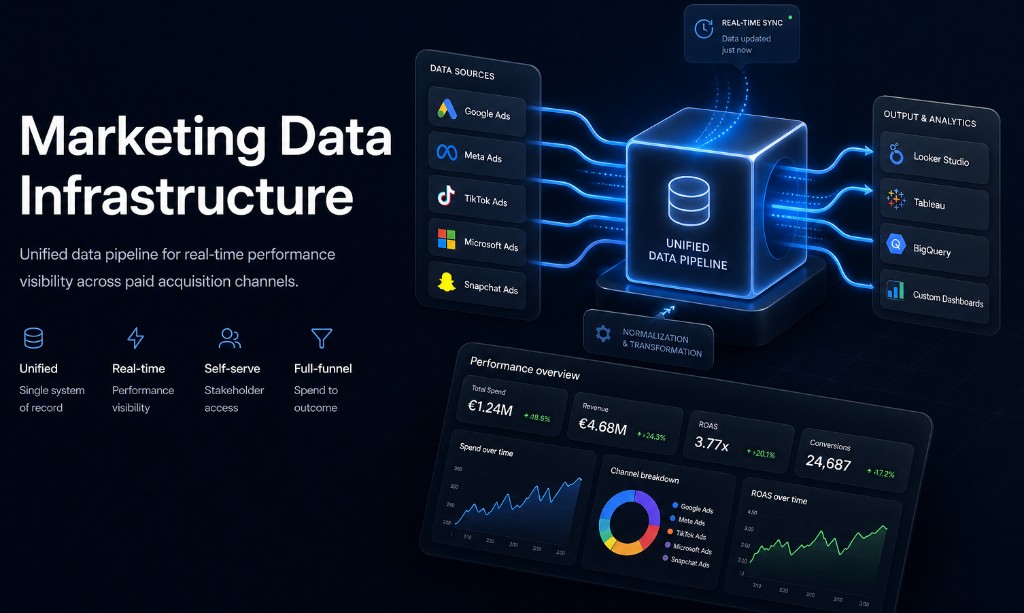
Built a unified data pipeline that integrates multiple data sources into a single, accessible system.
The pipeline enables continuous data ingestion, normalization, and access for downstream analysis.
Key components include:
Multi-platform integration
Aggregated campaign data across all major paid acquisition channels.
Full-funnel visibility
Combined advertising performance with product analytics to connect spend to revenue.
Automated data flow
Eliminated manual reporting through continuous, programmatic data syncing.
Self-serve access
Enabled stakeholders to query data and build custom dashboards without relying on internal teams.
How the pieces fit together
What changed for the business
- Eliminated manual reporting workflows entirely
- Reduced latency between performance changes and insights
- Enabled custom analysis and dashboarding for stakeholders
- Improved transparency and alignment across teams
- Created a scalable foundation for adding new data sources over time
A durable marketing data layer
A robust data infrastructure that transforms fragmented marketing data into a unified, real-time system—enabling faster decisions, deeper insights, and more efficient collaboration between operators and stakeholders.
Need to unify your marketing data?
Let me know if you need help building data integrations that give your stakeholders the visibility they need.
Get in touch